Eine freie Initiative von Menschen bei  anthrowiki.at, anthrowiki.at,  anthro.world, anthro.world,  biodyn.wiki und biodyn.wiki und  steiner.wiki steiner.wikimit online Lesekreisen, Übungsgruppen, Vorträgen ... |
|
|
Use Google Translate for a raw translation of our pages into more than 100 languages. Please note that some mistranslations can occur due to machine translation. |



Best practice of biodynamic preparations - 2 lecture by Vincent Masson, 2026
A B C D E F G H I J K L M N O P Q R S T U V W X Y Z | 0-9
| English eposides 1 - 2 - 3 - 4 - 5 - 6 - 7 ... |
| Deutsche Folgen 1 - 2 - 3 - 4 - 5 - 6 - 7 ... |
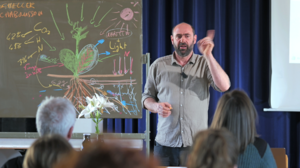
Transcription of the 2nd lecture on 2nd march 2026
Salutogenesis: Building Healthy Foundations 00:00:17
Vincent Masson: So, we start again. We finished this morning with looking at those two main lines in the course, interactions and salutogenesis. But I didn't say much about salutogenesis. And I should finish on the interactions, because I told you about the interactions in the first lecture, second lecture, third lecture, and we also have a seventh lecture that is only based on interactions, in what builds a landscape and how the diversity that you bring on the farm, in the landscape around — Steiner says this will also help and bring health on what's going on on the farm.
So we go from a very wide landscape to second lecture, the farm, diversity and landscape, to what's building the living in the third lecture. We go back to a landscape that is bigger than the farm in the seventh lecture. So interactions everywhere.
And then salutogenesis. How do you look at your health? Do you look at your health like, I have a problem, I need to do something, or, I should be healthy so that I don't have a problem. And we live in a world where many, many different aspects look like what we can call a pathogenesis. You look at the problem and you try to solve it. Many farmers, when they call me, call with a problem. Do you biodynamic guys have a solution to my problem? And usually I like to be a bit provocative and I say, no, we don't solve any problem. Our way is to build a healthy situation, and from there, solving a problem is very different.
But it's not true. When I asked how many wine growers in the room, many people lifted their hands. And being a wine grower in our time means managing an unhealthy situation. Because the plant is not healthy, because of the selection, the whole selection work that was made in the last 150 years, because of the monoculture, because of many different aspects that take us away from this idea of health. But even in such an unbalanced situation of viticulture, we can make little steps to bring more diversity, to go towards a healthier system. And there, where the preparations help the plant grow more roots, be stronger in health, there we need the preparations even more than on farms with the diversity, with this idea.
If you have the idea of a farm organism that is a reality on your farm, you have a base for health that you don't have when you have a more specialized agricultural system. And I use the preparations as something that I can bring more, because I need to do more to help the health. So I take the example of wine, but it's not only this plant. It depends on the kind of plants you grow. It also depends on how much you can have plants that have had a selection process in biodynamic conditions, because you can, in the selection process, work towards health, towards robustness. And with wines, we can't. Until now. Well, it's not that we can't, it's, we can say, legally impossible in Europe. Until now. But things — life is changing.
So, salutogenesis, it means, can we work towards healthy bases? And on that, the farm organism is something we cannot replace.
The Two Bases: Farm Organism and Preparations 00:04:42
So, to me, if I have to present shortly biodynamic agriculture, I see there's two bases. It means two things that are our identity. I call it identity because to me it means, if I don't have those two things, I'm not biodynamic. And this is the farm organism, and this is the preparations.
But, preparations, it's easy, you can just start and use them. And when you start using them properly — and that we will discuss, what I call properly — then we start changing our world. And it can be very fast. But I'll show you results of that as well. Things you can see within a few years, within a few months, and you can see. I mean, there's no question.
With the farm organism, we can build, we can make steps towards that wherever we come from. You have a little garden, small, like this part of the room. You can try to create a diversity on that. You can try to create a balance. You have a very specialized monoculture. You can make steps. When you have a farm organism with a good balance between what is from the plant realm and from the animal realm, you're far in advance on this health process.
If we want to bring the farm organism to something very short, to me, it is this proposal from Steiner in the second lecture, to say, have the right number and the right kind of animals for your farm. Enough so that you will carry the fertility, maintain or develop the fertility along the time. And no more than what the farm can feed. That's it. That's one sentence. But if you try to apply that to any farm, it's a long story. It brings you to many, many things. And that's great. That's the big game, in a way. Because there's what you see now, what you will see tomorrow, and then, and then, and then. And you will adapt and you will change.
Farm organism, an example. There was a research published in America, it was in 2013, about the home field advantage for fertility. It's a guy called Rashid and his team. People who have nothing to do with biodynamics, with anthroposophy. But they showed that if a cow is eating forage from the farm, the mist from this cow will be used by the microorganisms in the soil. And they will value much more this mist. And they measure that in terms of NPK, value much more that, than if the same cow on the same farm is fed with forage coming from outside of the farm. You build something on the place, a relation between what is living in the plant realm, transformed by the animal realm, and then transformed again in the soil.
So we have here something that is not new. In all the little images I took from the course, there's quite nothing new. Steiner — don't make of Steiner a great inventor. He took many things that existed, he just brought a new look at that. He just brought them in a very coherent reality. The preparations, for me, in the course, are the only thing that was new. But to bring together all those ideas at this time of the history, that was very important.
The Agricultural Context of 1924 00:09:02
Look, the farm organism, look at the landscapes. '24, we are in '24. We are at a time — because I didn't say that, but synthetic nitrogen was very welcome at this time. It is the time where there's less and less animals, less and less manure. Before that, the army was riding horses and then driving trucks. A truck doesn't produce any manure. I mean, you have other revolutions. If we look at this timeline, we need to look also aside and see that this was very much going with the time.
Then you start, in Germany, you start around 1900. We have the start here of, speaking French, Le Remembrement. Who knows how to translate Le Remembrement? In France, from the '60s on, we start making from many small farms few big farms. We cut the hedges and we dry the rivers. Is there a name for that in German?
Audience: Flurbereinigung.
Vincent Masson: Flurbereinigung. Flur. Flurbereinigung. And in English? So, we take the German. Flurbereinigung.
Audience: Land clearance.
Audience: Land clearance maybe.
Vincent Masson: Thank you. Land clearance. Flurbereinigung. And that develops also. So, I can tell about the French situation. In the '60s, it's going against the farmers, but against all the people from the countryside. Most of them fight against that. And that's a big step in the evolution of agriculture.
But this started in — in France, it starts in '43. In the north of France. In the part where the Nazi army is. They have been working on how to make a very productive agriculture based on nothing coming from outside. That's important to know. In the '30s, most of the best French agronomists moved to Germany. They called them because Germany knows what's going to happen. If you prepare a war of invasion, you know that no one will feed you from the outside. You need to produce your own food. That's why also the Nazis were interested in an agriculture that speaks about self-sufficiency on the fertility point of view. There's many things to explore on this level, but it's interesting. We can understand many things.
What happened in the '60s in France? Finally, when we look back in history, the first steps of that start around 1900. When Steiner speaks about the importance of the diversity in the landscape, he speaks of something that still exists, but will soon — not disappear, but quite a lot disappear. When he speaks about the farm organism, it still exists in France. We can say that all the farms had a diversity until the '50s. All the wine estates in France, until the '50s, '60s, also had animals, also had trees, also had a bit of crops. It was diversified. It's not long ago that it changed. Steiner brings something that will be useful, and he brings it in advance, and happens what happens.
Defining Substance and Forces 00:13:20
The two bases, farm organism and biodynamic preparations. I think now we will focus a bit more on the preparations. I wanted to make this introduction just to bring them in a wider context. It would be easy to say that I speak only of biodynamics being the preparations. Yes, this is where I think I can bring something, but it comes in a wider story.
Maybe a word we should define first. Forces. We know about substance. Substance. This is made of substance. We can touch it, we can weigh it, and so on. If we want to understand the preparations, we need to have an idea of what are the forces.
We can say that any substance is the result of a process. Any substance is the result of a process. Some people will tell you that a process dies when a substance is born. I rather say that in a substance we find the result of a process. And the work of people working for pharmacy, making remedies — usually the point is, how can we get out of a substance, how can we get the process and activity back again. We have a substance. We put it in a medium. It can be water, it can be something else. And through the potentizing, which is a kind of dynamization, stirring, then we get an activity. But for that we need to have the right state of the substance. And usually the right state of the substance is the colloidal state of substance. We will speak of that with much more details later. But it's just to give an image. How is it your state of substance? Colloidal.
Etheric Forces and the Vegetative Phase: The Equisetum 00:16:07
And one example. If we look at processes in the growth of the plants. It's again something I put now out of nowhere, but it will be useful later.
If you look at the plants, what's going on in spring? Soon. The plant is going to start its vegetative state. Vegetative phase. It will grow, it will make substance. It will make green. It will be a plant. And that is, if I want to make it very simple, I do it like that. The plant is growing. This is the vegetative. This is growth. This is expansion.
And if we want to talk of forces with the words that Steiner uses, we can say we have here the activity of the etheric forces. Etheric forces, it is basically metabolic forces. Transforming and generating growth.
When we use equisetum, now, between the winter and the spring, it's because the equisetum is a plant that has all the conditions to have a huge metabolism, because it grows in humidity with a lot of water, and it does the opposite gesture. It does not take those metabolic forces. It contains them. And we bring this equisetum as a model for the metabolic forces. We can call them metabolic forces. We can call them — Steiner, in the sixth lecture, calls them the moon forces. He says when you have too much of the moon forces in the soil, in winter, in the beginning of spring, they might come back up on the plant. What does it mean? What do we have in the soil? What do we want in the soil? We have those metabolic forces that digest.
A fertile soil is a soil that is able to digest. If those metabolic forces — we can call it the microbiome. Microbiome, it's a very easy word, and it's very efficient now. Everyone studies the microbiome. Everyone shows beautiful results about biodynamics on the microbiome. Don't forget that it's only one little part. It's one view on what we do with the preps. We have a great effect on the microbiome with the 500 preparation. Yes. But the microbiome is there because there is the forces here, the metabolic conditions.
So, when we use the equisetum — I don't know. Maybe we'll take the time to speak more about the equisetum. Otherwise, we will have a little view on it. We bring an example to this metabolism to stay in the soil and not grow on the plant. We want a soil with a good metabolic activity. But if this goes on the plant, what does it mean to bring the metabolism on the plant? Fungi. They take the aerial part of the plant, and they digest it. Not the aim for us. The equisetum will contain this, but not on the general level, just from the soil to what's on top of the soil. So, this was just to make a relation from etheric to metabolic. And you will get used to that. I jumped from one thing to another, but I'll come back.
Astral Forces and the Generative Phase 00:20:29
Now, this is a gesture we have in the plant. Another gesture we have is — we have here the vegetative, we have here the generative. Generative. Generative means fructification. And to make a fruit, the plant will need to bring concentration. We'll need to use astral forces. Astrality comes with the animal realm. Astrality comes with the shaping of an inside, the differentiation between an inside and an outside. It brings the mobility, the ability to move, the ability as well to react to the world around, and inner life, which we don't have in the same way in the plant. So, this will be a gesture that comes that way.
Where do we find those two tendencies? This is in our season. What does the world look like in winter?
Heavy and Light: The Organization of the Physical World and the Senses 00:21:54
Maybe before that we can have a look. Just coming back to what we said earlier, we have the soil. And even before the soil, we have the rocks. Then we have the soil. Then we have the water. Then we have the air. And the air, it goes a bit, a few kilometers. I look at substances. I look at this, what I described as a physical world. And the rock is more dense than the soil. The soil is 1.3. Never mind. The more we go up, the lighter we are. And here we will have the light. We will have the warmth. We still have some gas here when we go further away from the soil. And this will be hydrogen and helium. And those are the lightest that we have.
If we look under us, we have a physical, material, heavy world that we can touch. And the more we go up, the more we go into light and things we cannot touch. It's a funny thing as well that in our senses, the organization of our senses, we follow this intelligence. What can we relate to with what's under our head? If you close your eyes and if you imagine you don't have the senses from the head, you can't listen, you can't see, you can't taste, you can't smell, you can only touch. And if I touch from here, I don't know if there is something here. I need to touch. I need to be in direct contact. Then you go up to the mouth and you can taste. And we need the solid and the liquid for that. So we still need the contact. With the nose, it goes through the air and we can smell things that come from far away. Same with the ears, and they are at the same level. Funny. And with the eyes, how many millions of kilometers from us is the sun? But we see the light. And if we go still a bit higher up, we can go into things that are in a different reality, and we can even invent things. So the more we go up, the more we get free from the physical reality. It's just a funny image.
Winter and Spring: The Breathing of the Year 00:25:02
Now, what's going on in wintertime? Back to our point. How is the water in winter? It's hard. How is the air when it's humid and it's cold? Sometimes you have the feeling you can touch it. Okay, everything in winter looks more like a stone. The soil, the life — sorry, everything is more like a stone. More on that part than on that part.
And how are we in winter? Beginning of winter, most of the people — no, many people, life is a bit more heavy. Life is a bit more sad and you have the mouth going like that. And then you have a few sunny days arriving and you say, oh, spring still exists. And you feel lighter and life will come back. We have in winter a process like this that takes the whole of our — I was going to say our planet, it's not true — the part in which we are. And in spring we go in this direction.
When do we bury the preparations? We bury most of the preparations in this time of the season. And what is going on with the plants when we go from here to there? They start, they grow, and at the most they make the flower. But the flower was built before. The flower was built in this process the previous year for most of the plants. The flower is not the daughter of the winter. It is the daughter of spring and summertime. But it has the push to go after the winter. So we have this breathing.
And when we bury the preparations in winter, they take in a process that they will be able to give back with the spring, and they will push this growing etheric process. And the 501 silica that we bury in this time will be able to bring a model to the plant to do that, to concentrate. We bring the silica — we should bring the silica preparation in springtime first on the plants when they start growing fast. Because at this moment we help them grow stronger with a better structure, with stronger cells; everything that is built is stronger. And this brings health all along the season. And then when we bring the 501 preparation when the plant is doing that, it means on the fructification process, on the maturation process, then we help it getting well together, getting better concentration, better maturity, better balance in what is concentrating there and so on.
So we can — there's many, many ways to look at the preparations. And I like to look at different ways. So this is one proposal again, how to understand the preparations in relation with those processes in the season. What we do, what we accompany, which process we want to have in them and how they express themselves in the season.
The Definition of a Force 00:29:13
A little more word about — I said we should look at the idea of a force. The definition of a force, I have it in French. No, I know it's a little close like that. But it's very simple. In English it says, any cause able of altering the state of motion, of rest of an object, or of changing the form of that object. In German, I don't know if the translation is — look, I just made it quickly before.
Audience: Does it make sense?
Vincent Masson: Does it make sense? So when you have something that is rolling and stops, there was a force that stopped it. But there was also a force that made it roll. When you have a leaf that is growing like that, there is a force that makes it grow like that. But if it grows like that, it's a different force. Do we have forces of verticality, of horizontality? The definition allows many, many interpretations.
What do we do when we push a plant to grow like that? If I have a plant and I want to push it like that, I bring the plant in the leaves, I bring the plant in the substance. It's very different than if I want to push the plant towards the fructification. Example: there was a Belgian farmer, a long time ago, when people discovered the use of the biodynamic preparations, and when he saw the effect of the 500 on the wheat crop, he pushed it in the growth, and he said, this is amazing. And he went again and again, and he spread seven times the 500. And he never had such a vegetative mass. It was huge, but it was not able to make a fruit.
If you spray — usually the most easy to see is on vegetables. Some people sometimes say they just want to use the 501, because they're not interested in biodynamics, but it seems that with the 501 there was a better taste in vegetables, and stuff like that. So they will only spray the 501. You didn't push, you didn't help this, which can be helped with the 500. And you directly go to the 501. What does your plant do? It was not finished with growing the vegetative part, and it goes to the flower and to the seeds.
Which forces do we stimulate with one and the other? That's something, again, we can look at when we use the preparation. What is the imbalance of the moment? What is the difference between this field and this field? So, that will complement our discussion.
The Preparations in a Wider View: The Aging Planet 00:35:06
We can look at the preparations in a very wide way. You know that Steiner has this understanding, this view on the evolution of the planet. As a planet, before being the Earth, being first a body of warmth — I say in a few seconds something that took ages to happen — but a body of warmth turning to a body of gas, and then something more liquid, and then something more solid. You know what I'm talking about?
And what is it when it is completely solid? It's out of life. No more life. When you have the wood here, it is completely solid, it is out of life. When you have a stone, it is out of life. That's where we can say we have a process that ends in a substance.
And the planet is not in a completely mineral state. It's not in a state of being out of life. We see that the soils are getting more and more compact, and we gave a few ideas about it earlier. But if we look on a worldwide scale, we see — and it's not new, it's more than a century now that we can see — that the desertic places get wider and wider. The fertile parts of the world get less and less fertility. The humus, the fertile soil, is getting thinner and thinner. The soil is losing a breathing ability.
I said this morning that at my place, and on the white part of France in the last weeks, the water was just — like the soils could not take water anymore. But in some places it was a lot of water, and in some places it was not a lot of water. But still it was too much for the soils. And in my valley — my valley is the one you see when I do that. I live here, we make the preparations here, and that's the valley. And the rivers here, there's one river there, another one there, they were out of their bed for weeks, and all the fields were covered with water. And when it stopped raining, it took three days, and the water was back in. And two more days, and you have this feeling that it will be too dry. And to me, there is something not fluid, not working, in the soil breathing, in the soil capacity to manage those movements, to be something alive.
Steiner relates it to the aging of the planet, a planet which is in the way of aging. And as we, as living organisms — the more we get old, the less it is easy to heal, the less it is easy to rest. You see how a little child is able to grow so fast, how a wound for a child is a matter of not much. Hey, I'm not in the same state. And I will go in one direction. And at the end, I will only leave bones, the stones that I built all my life, right?
So, if we have this image of the planet as being an aging organism, losing slowly the capacity of breathing, of being alive, of carrying life, of being fertile, and if we bring on top of that the fact that the human is very able to increase this by its activity, through the various pollutions, through the way we farm. What do we do with chemical farming? Be careful, in France we say conventional farming, as if it was normal. And many people make the mistake to say, well, this is the normal way, or traditional way. No way, it's not traditional. A tradition takes a long, long time to become a tradition. Chemical farming is the right name. And chemical farming started not long ago.
So, what do we do when we bring synthetic fertilizers to the soil? The soil is becoming a stone. The stone soil is getting out of life. And I see more and more, in the biodynamic movement, people who want to bring very young compost. Very young means 2-3 weeks of composting. This is not compost. This is the same way, soluble. It's interesting because it pushes the growth of the plants. But we don't play the role we can have as biodynamic farmers to be a positive actor of developing a fertility for the soil, a breathing capacity for the skin of the earth, which is this fertile little skin on top of the planet.
Biodynamics as a Positive Contribution to the Planet 00:41:07
So, with the preparations, and with this biodynamic agriculture, Steiner proposes a way for the farmers — instead of hurting the planet, instead of contributing to the negative evolution, negative from a life point of view, he offers a way that will become, in our interaction with the planet, positive. We can build a positive evolution towards more fertility, towards more ability of the planet to carry life. And this is something important that we can have, and we should have somewhere in our minds, with agriculture. And this is something that we can do with a physical result. I always think the physical result I have on the soil is the effect of the highest levels, like etheric forces, astral forces, and so on.
So, we can look at that. This is — who can read that? The German part, and the English-speaking people can read it. Can someone read that? For Steiner, what we have on Earth is the result of impulses coming from the periphery. But the world is not there anymore. So, we can accompany it so that it goes a bit further. And if we go a bit further than that — why would we do that? But we have to join to this question, why are humans on Earth? And that is, if the story of the human being is a long story of a spiritual being, if the aim of this physical life is to develop something, to take a step in this evolution, then we're not completely finished with that. And then, it might be useful to allow the planet to allow us to live a bit more. I don't go more on this topic now, but it's a nice way to feed what we do.
And then we have this little sentence from Steiner. Our task today is to take hold of the more or less dead substances of nature and lead them back to the spirit.
The Preparations as Remedies and Cosmetics for the Earth 00:44:25
We can also look at the preparations as remedies. As remedies. remedies or cosmetics. What do we do when our skin is not working well enough anymore? It needs a bit of help. And you don't have that when you're young. And one day you realize that, huh, it was not the same before. And you have some people who make products that can help with that. Like a little cream to make it more subtle. And we use the cosmetics to help our body carry on when we don't have the forces enough anymore so that it does it by itself. So if the planet has this problem of having an aging skin, having an aging body, maybe we need to bring an impulse as well, like what we would do for ourselves with the remedies or with the cosmetics. Would the preparations be cosmetics for the Earth?
That was an idea, that was a very strong idea for my father. My father developed that in a beautiful way in a lecture he gave in 2018, in the Goetheanum in Dornach. And he died in the same year. But that was something in his life that was important. My mother was a medical doctor. And my father took a lot of inspiration and of knowledge in the documents for doctors and for the pharmacy. And for him, the remedies, the preparations were on the same level as remedies. And remedies, you don't do them just as you think it is right. You have precise indications, it is ruled in what we call the codex, that is the quality of plants that you want to have, that is the way to transform, that is the way to make the remedy, that is the way to use it, that is the way to make sure it is working in the right way.
And he was hoping that we would go towards such a way with the preparations, because what the world can see from our movement is the results. And you can say the most beautiful words about how happy the spiritual beings are around when you spray the preps, how important it is to have a beautiful intention, to have a right relationship with the living on your farm. If you don't show a difference in the soil fertility, in the quality of your agricultural products, the world outside doesn't care. And we are in a time of the world where we need to show results.
And so the idea was, all along these 100 years — a bit more than 100 years of development of the biodynamic movement — some things have become a quite precise knowledge. And this should be used. And it is interesting, and that is where we will go a bit into the history, because we will see that some knowledge has been developed in some parts of the world, not understood the same way in some other parts of the world, and how things went. It is interesting to have a view on that. So we will take a look at that.
Anyway, if we want to see the preps as remedies, we need to have a lot of precision in how we do them, in how we use them. And this is a big responsibility. Very often on farms, when I see the quality of the preparations, I think, if the cheese was made in the same way, you would not sell it. You would lose your clients very fast. It's not always. But sometimes, I think that. So, I think our responsibility is that.
We observe that compost and biodynamic preparations made and applied according to certain criterias offer impressive results in terms of evolution of soil, structure, and fertility, but also in terms of plant robustness and product quality. Intention, inspiration, personal sovereignty, the will of the individual at work, or creativity can complement this good practice, but they do not replace them. Biodynamics has suffered in many places from having few visible results. Consuming biodynamic products is unfortunately not always a guarantee of the quality that one might expect. We believe that if good practice was better known and more widely recommended, our whole movement would benefit in terms of result, image, and recognition. This is what we would like every farm and every garden to benefit from. And this is our responsibility and duty to act on current knowledge and to continue to improve it. That is what we are going to try to do now.
A Tour Through the Literature: The History of the Preparations 00:51:01
I would like to invite you on a little literature tour. I wrote an article in English in which I think you can find many of these things. And I'll show you how to get it on the Internet. Or I can send it to you, but I don't have everyone's email address. If there are slides that you really want, write it and then send it to me. I didn't plan to make something to give, but it's possible, everything is possible. It's not possible to give you everything, because I will switch on many different documents in my computer. So, write what you want, and we'll look.
This is in the article. It's my article about history. A few years ago, I was invited to talk about the history of biodynamics. And I said, OK, the part of it that I know and that I live with since 20 years now and that I am very interested in, is the preparations. So, I tried to find as many documents as I could from the beginning, from 1924 to now, to see how was the evolution in how to understand the preparations, how to make the preparations, how to use the preparations. I've had the help of someone that knows the history very well. He's called Walter Stappung. Walter Stappung — I don't know if you know the book that he made. Do we have this book in the Dottenfelderhof? Yes, I can bring it. Maybe we can bring it later. It's this size book, but it's thick like that, like 800 pages, something like that. And he gathered a lot of information. And he helped me to find the interesting documents for what I was looking for.
And this is just to give you a little idea, because I will refer to some of those documents. So, we find descriptions of the elaboration, the making, and of the application, the use, of the preparations.
First document, Willem Spies. This is in March '26. He's a pharmacist, and he will talk about the quality of the water that we should use to use the preparations. And he has the understanding of the preparations as such a precious substance that he says that the best quality of water would be the dew water. The dew water, the humidity you have on the soil in the morning. He said we should collect that to bring the preparations. Good luck. But we are at the beginning. And you see, that means that he was really looking at them as very precious substances.
Almar von Wistinghausen. Almar was the youngest guy attending the course. He was 20, I think he was 20. And he was part of this group. There was a group of young guys that were really calling for the course and that then became very active in the development of the biodynamics. They went from farm to farm to spread, to share the knowledge, to give the information of what was made here and there, what results were observed and so on. And Almar von Wistinghausen, he then had two sons that were quite known in the movement. Christian von Wistinghausen, who made the preparations, and Eckart von Wistinghausen, who worked in research. Almar von Wistinghausen, in 1928, has this little document. He writes the Praktische Anleitung zur Anwendung der biologisch-dynamischen Wirtschaftsmethoden. This is the first practical guide about the use of biodynamic preparations. And it is that big. This is the German version, right? It's not long. We're in '28.
The chapters. Das Präparieren des Dünghaufens. Dünghaufen. Entschuldigung. Präparat Nr. 500. He says 500. It doesn't say cow manure or horn manure preparation. It says 500. Präparat Nr. 501. Präparat Nr. 508. Und Sammelpräparat. And we will come back to this Sammelpräparat later. Because this compound preparation, we can call it in English — it's what you use if you use the Fladenpräparat, the Maria-Thun preparation. It's what you use if you use the Präparat Nr. 500 that Alex Podolinsky developed. But there were many different ways to answer the same question along the history. And the question was, how to bring the compost preparations if we don't use compost. Because those preparations should be used every year on the whole farm. That is what Demeter asks you for, to be certified. It's one part of what is asked. But it's also the reality that if we don't have those preparations, we see a difference. We see a difference. It means we see the effect of those preparations on the farm. So, yeah, we will come back to that. But it's interesting to see that it's present in the history since the beginning.
Then, next year, 1929, Gaa Sofia. It's a book that is collecting, gathering articles from many different people, many actors of the biodynamic movement at this moment. And we have the same document, this one, but there is another hand that put complements. There is a bit more details. The next step will be Franz Dreidax. And this is an article in '30. Then we will have Helmut Bartsch. And this is different articles in what was then called the Demeter newspaper in '30 and '31. Then we have Pfeiffer, a little booklet about using the biodynamic compost preparations and the sprays in garden, orchard, and farm. And we have something very clear in all those documents. Each author is taking the knowledge from before and is bringing it a step further. But they are all in the same line.
Marna Pease, Instructions for the Making of Preparations in 42. That is published in England in Bray on Thames. And it's the only document in my list that I did not find. It's gold. If someone has it — I have an idea of what is in it, and I will be very interested. Because Mrs. Pease is the one — Eugen and Lily Kolisko left continental Europe to England in '36. And they were welcomed in England by the Peases. And they worked together. And Kolisko is one of the persons who made the most research work about the preparations. But she doesn't describe in her book — maybe you know this book, Agriculture of Tomorrow? She describes many things on the effect of the preparations. And she confirms, basically, many things that Steiner went about — Steiner went about the preparation, got information from the spiritual world, if we want to make it in a very short way. He was able to explore the spiritual world, which we can call this suprasensitive world, to refer to what I said before. He was just exploring this world as I see you. And he brings things from there. And then he said, but now, before we use it, we need to make sure it's right. And Kolisko was the first. Not the only one, but she was one of the major actors of this work. And I think in this little booklet — in there, there might be very interesting details on how to make the preparations, how Kolisko was making them. And Kolisko had amazing results with her preparations.
And then we have Agriculture of tomorrow — sorry, this is wrong. It's not '47, it's '46. It was published in English in '46, and then in German in '53. And in Agriculture of Tomorrow, Kolisko — many of you know this book? Not many. We made the translation and we published it in French in 2017 because we thought it is one of the major documents of the biodynamic development. Kolisko, there's three big parts, three major parts in this book. One is about the influence of the moon on the plant growth. And that's the work she carried — when she published in '46, she had started this work, I think, in '23. A second part: she was asked by Steiner to work on the activity of very, very small quantities of substances. And she made a huge work about homeopathic dilutions and the effect they had on the growth of plants, aerial parts, roots, and so on and so on. And this is an amazing work. And the third part, the bigger part of the book — and it's a big book — is about the indications Steiner gave during the course, all the practical informations. Does it work or not? And it's a huge work. She started in '24, some things she started in '23, and until '46 she spent her life making experiments on many, many different things. This book is out of print in German since a very long time, in English since a very long time, but you can find it on the Internet. You go on a website that is called Soil and Health Library. They have plenty of interesting documents and they just ask you to give whatever you want. It can be one euro, it can be a hundred euros.
Audience: You give whatever you want and then you take as much as you want.
Vincent Masson: And you can have it in English, in German, and many other things. Soil and Health Library.
Then we have Immanuel Vogele, a little booklet about how to make the preparations, and it's a little red booklet like that, and I think it's published with the Forschungsring. And the next edition of this book will be from Christian von Wistinghausen and Wolfgang Scheibe in '81. In between we still have Franz Lippert. We don't know exactly when it was written, before '41 anyway. Published in Lebendige Erde in '67. Again, a document about the preparations. I'll go a bit faster. Now, Harald Kabisch. I don't know when it was published in German, but it was translated in French in '76. Practical Guide to the Biodynamic Method in Agriculture. Then we have this booklet I just named from Wistinghausen and Scheibe in '81, and then there were some subsequent editions.
I name you all that because we will see the evolution in that. Alex Podolinsky. A few pages. First publication in '93 and then subsequent editions. Again, very practical way to use the preparations. Pierre Masson. Guide Pratique de la Biodynamie. It was here. That started as a very little booklet, a few pages, in 2003, and then 2012. It goes to more and more content. Translated in many different languages and is now one of the basics for applying biodynamics. If you have it in English, it is a horrible translation. Don't use it. You might make too many mistakes. But the German translation was much better than the English one. There might be a new translation in the coming years. I don't know.
Then we have Wistinghausen again but with Scheibe, Heilmann, König. Anleitung zur Anwendung der biologisch-dynamischen Präparate. In 2005. You have here zur Herstellung and here zur Anwendung. Again, different editions. We will see an evolution in that. Then a more recent one. This one. Arbeitsbuch Biodynamische Präparate.
Audience: That was a project to write that with my father.
Vincent Masson: My father died too early for that. I made the work. It was published in France in 2021, then in Germany in 2024. It is now, since a few weeks, in English. How is the translation to English this time? This time to English it's good. Because you learn from your mistakes. With English I can. With German I can't. I checked everything and I put in a contract with the editor that I need to check every word before they do whatever. I wanted to make sure of that.
So, and that is for me the knowledge we have now. And you have the same with Almar von Wistinghausen. It finishes with a little sentence to say, this is the state of knowledge we have after four years of experience with the biodynamic methods. It is only a state of knowledge. It will evolve and we need to follow this evolution. I put the same in this book. This is only where we are now, and we cannot be pretentious enough to think it will last long. In five years, in ten years, we will have learned more. So, that is where we are now.
And we will look at how those people did not all get along well together.
Audience: Some different directions were taken.
Vincent Masson: Some conflicts were there. And it is important to have an idea of that, because we live with the result of this history. And if we don't have a clear view of the history, we cannot see where we are and where we come from. So, we will, at a stage or another, have that. But quite often I will tell you, in the documents, in the literature, we see this and that. And that refers to what I said here.
Results: The Original Preparations and Their Numbering 01:09:37
I think now it is time to show you some results. And there are two kinds of results that I want to show you. One part is about results on the soil. One we can see as a direct effect of the use of the preparations. And another part is what we can have for results — a few results from more institutional research. Because now we start having a lot of interesting things. To me, it is interesting when it shows that biodynamics is better than organic. Of course. But it is very objective results. Scientific people making good work, and it is good to have an idea of that. Then we will look at how we get to these results. This is the way my experience — and not only mine, but my experience — shows the best way to use the preparations. And then we will come to how we make the preparations. Is that OK as a program? So we are quite finished with the introduction.
Field observations with the biodynamic preparations.
Question : what is 500P ?
Then maybe I clear that up before. OK. If we look at the preparations, the original preparations from Steiner, we have the 500. As you noticed, in '28 already they were named by numbers. And the first document mentioning the numbers is from '25. From the Count von Keyserlingk. So it was not — many stories go around why the numbers. It starts from the beginning. And then you had many people who used it. I use it.
And, yeah. Alex Podolinsky, for example, was saying, I use the name 500 because it is completely transformed. And it has nothing to do anymore with manure. He was saying, if you use the horn manure, it relates to a preparation that is not well transformed.
Audience: The idea is, it is not that.
Vincent Masson: So, 500. Soil, fertility, root development, plant growth, metabolic system — a metabolic preparation. When we use it, we bring metabolic forces. That's just an image. But images, you know — remember when we were children. Images, that was the best way to learn the world.
We have the 501. And that goes on the health, for everything, the health of the plants. But also it makes a difference on the quality of the forage for the animals. It makes a difference on the quality. I would like to see — I went to the shop during the break to have an idea of how is an organic shop on a biodynamic farm in this country. Is it only Demeter products? And I would love to see, oh, Demeter apples. How many times the 501? And when? But it makes a difference.
The 501 in Practice: The Austrian Apple Growers 01:15:36
Look, a little anecdote, a little story. In Austria. I was in Austria not long ago. And I speak in this country since quite a while. And there's a whole group of apple growers using biodynamics, they are Demeter certified. They got a beautiful place on the market for the apples because they make the difference. And you know how they make the difference? The average on the same distribution channels — the average of loss during the storage of the apples is between 7 and 8 percent for organic and conventional apples. They have an average of 0.7 percent of loss. It makes a big difference. It makes a huge difference. So the shops want to buy the apples and sell the apples. They put it in front.
Audience: They show, this is the Demeter quality.
Vincent Masson: It makes a difference. And they also have a difference in taste. But to reach that, they use the 501 a lot. And a lot — it doesn't mean you need to use it a lot every year. But the last season, for example — so those guys are in the south, in Styria. And they had a difficult season from a climatic condition point of view. And some of them used 14 times the 501. It's a lot of work. But they could harvest healthy apples, tasty apples, and they have a good storage behavior of the fruits. If you have a sunny season, you don't need that much. But the 501 preparation is able to balance if you have a lack of sun, if you have an excess of water — all that, the preparation is able to do. And that is something important for me. We don't spray ideas. We don't spray just because we have to spray. No, we also can use those preparations to help the plants, to help the soils, considering what's going on around. And our world and our climate is going more and more — and we don't know which direction because it changes all the time. And we have, with the preparations, something that can be a help, a direct help that we can use in the soil.
So, 500, 501, and then we have those which we called compost preparations. And this is 502 to 507. Then we have the equisetum, the 508. And with that we have all our preparations.
The Problem: Bringing the Compost Preparations Without Compost 01:19:08
I'm checking with this. So, and then — Let’s look at Wistinghausen. Can you read? That's quite big. Are we ready? No, just try. Okay.
Audience: Some preparations. When the effects of the preparations of the compost cannot come to light in the desired way, the preparations 502 to 507 will be added together. So, the preparations 502 and 507 will be stirred together in a mass of one hour. Some studies. So, interesting.
Vincent Masson: We have a problem. We have a problem. We don't know how to bring those preparations. We need to find a solution. And there's many crops where you don't want to bring compost every year. There's many farms who don't have enough compost to bring compost on the whole farm every year. And you want — just looking at the Demeter standards, the Demeter standards are not based on nothing. They have evolution along the time, but still they're based on something. You want to have this every year on the whole farm, this every year on the whole farm, this once per crop. Some crops go every year. Once per crop, per year. And this is forgotten in the standards. It's too simple. It's just a dry plant.
Audience: Yeah, I mean, I think I'm right.
Vincent Masson: In France it's not in the standards, and I think at the international level either. But there was an interesting point that was brought to my consciousness by a man called Hugh Courtney from Northern America. And Courtney — it was a bit more than ten years ago, and he told me that, look, it's obvious. Everywhere where you see results from the preparations, all of them are used. And I started thinking, and what I will show you — everywhere I can show you the results I will show you, the equisetum is used as well. So I don't know if he was right, but it's a question we can have.
So, those compost preparations are supposed to be used through compost. IAnd in '28 they've tried already to just stir them. Now, I'll show you different ways that have been proposed, tried, developed, along the years.
There was a man called Max Karl Schwarz. He was very active also in this group from the beginning. And in the beginning of the '30s, he proposes the Birchpit preparation, a bit like the Maria-Thun preparation, in the same way. Pfeiffer made a compost starter, a powder, a dry powder, very easy to bring in the compost piles. Same idea, you find it with Christian von Wistinghausen and the Mausdorfer Rottelenker. Pfeiffer also worked on a biodynamic field spray. His idea, I told you, was to have the biodynamic preparation spread on as much surface as possible. Because he was concerned with the fact that people should be able to eat biodynamic quality food. So, that was a spray, a dry powder that you just pour in water. You do that, and you go and spray. And all the people who have seen that work say it worked in an amazing way. It means a big effect on the evolution of soils.
It is the only thing in the biodynamic movement that I know has had a — how do you say a brevet?
Vincent Masson: It is a very common word. Brevet, breveté, le vivant. You put a brand on something.
Audience: Brevet.
Audience: An ownness.
Vincent Masson: Un brevet. If you call Monsanto and you make a new maize variety called —
Audience: Patente.
Vincent Masson: Patente, thank you. Sorry, this word is completely outside of my world.
Audience: Good, good, good.
Vincent Masson: But Pfeiffer put a patent on that. And the result is that it is dead. This knowledge was good, but it is dead. And in the whole biodynamic movement, the knowledge is made to be shared. Not sold. The knowledge cannot be with a patent.
So this was a try. Niklaus Remer in the north of Germany made the Sammelpräparat. Maria Thun in 1972 started working with Pfeiffer. And she made the Fladenpräparat. Which has many names around the world. And it is put in bold because it is one of the ones that are still used around the world. Then Remer — Niklaus Remer again — in 1980. It is in the book called Organische Düngung. And he proposes to put together 500 and the Fladen. And to stir them together. Then in the United States you have Walter Goldstein. And he makes the recipe of the barrel compost with the nettle. And he says it is more efficient on the root development and on the yields than the Fladen preparation. But no one cares because he doesn't have the name that Maria Thun has. He also makes something called the Super 500. And we have Alex Podolinsky in Australia, that makes the Prepared 500. He takes the 500.
Audience: When you make the 500 it is made. You have it in the cellar.
Vincent Masson: You care for it until it is stable. And then you bring the compost preparations inside. And you again leave a maturation time. And then you will use it as the 500.
So all those are different ways to answer the same question. How to bring the compost preparation when there is no compost. So if I want to bring it to something simple. Now you can bring those preparations through the compost. Through the Fladen. Or through the Prepared 500. And then the different ways we have now in Germany, but also in France and in different parts of the world, are mainly in relation with how those people managed to talk together and to have relationships together — or not. And we will come back to that at a stage or another.
Alex Podolinsky and the Importance of Knowing the History 01:28:05
To me, Alex Podolinsky is one of the most important guys in developing knowledge. And if I am able to show you what I am going to show you now, he is one of the responsible for that. Very positive improvement of the way to make and use the preparations, the different preparations. But on a social point of view, he was a really hard guy. And he got in conflicts with many people. And that is why any time you will meet people that have a negative reaction when you speak about Podolinsky, when you speak about the Prepared 500, when you speak about Australian-type stirring machines, usually it comes from old conflicts and not from practical results, comparisons and stuff like that. And that's why I told you, we need to have a look at his story. Because we are the result of a history. And if we want to get free from that past, we need to look at that past. So, we will get more details on that.
Audience: But you have a little idea already.
Vincent Masson: So I work on the line of Alex Podolinsky. I work with the Prepared 500. And what you are going to see — and we were here, and thank you that you asked the question. Because I could explain all that. So, the idea was, field observations with the biodynamic preparation Prepared 500. So, 500 plus compost preparations. Yeah. Not this one. This one is not with Prepared 500. This is far before. This is to give an idea.
The Experimental Cycle: From Secret to Publication 01:30:17
Research went on. We can come back to this timeline. Research starts here. June '24, second day of the lecture, Steiner gathers people to create the experimental cycle. And from '24 to '38, the content of the course is only for people belonging to the biodynamic movement. For all the rest, it is a secret. Because Steiner has asked that nothing is shared before it is sure that it works. And that it works on an agricultural level and an economic level as well. And that's important.
We have in France at the moment a few people who try to push, say, biodynamic. It looks like a sect. This is very strange. And Steiner was not a guru. Steiner was a very pragmatic guy. He never said to people, just believe me, just follow what I think. Never. It was always, make it your own. And on these agricultural indications, it was very clearly, we first need to make sure it works. And it's only in 1938 that the group decides that, yes, it is valid. It brings to good results. We know how to do. We know what we can expect. And now we can have the first publications. And in the list of documents that I showed you, all the early ones, it is only for the circle. In '38 you have the first publications that are open.
And in this time, a lot of experiments. This is a good example of someone that worked. Because I will show you some bits of experimentation.
Audience: I experimentted with biodynamic preparations.
Vincent Masson: I don't experiment the farm organism. And, for example, Alex Podolinsky was in complete disagreement with what we do.
Audience: He was saying, no, biodynamics, you have to use it as a whole system.
Vincent Masson: It's the whole farm you take in. If you want to compare biodynamics with something else, it's whole farms that you should compare.
Audience: And that's what he did.
Vincent Masson:There are interesting publications in Australia. There's like five dairy farms. I think it's five on one side, biodynamic. Five others in the same valley, conventional, and there they can compare things. This is not what I did. But that was also — that is here an example, an interesting example.
Bartsch in the farm called Marienhöhe. It was, in a way, given this farm. And it was very poor. Very, very poor from the soil point of view, from the fertility point of view. The health and the productivity of the cows, it was very bad. Everything was bad, from an agronomic point of view and from a economic point of view. He takes the farm and he brings all what we have, all the proposals we have in the course. So not only the preparations, but also planting trees, planting hedges, working on the adaptation of the seeds, which plants and which seeds should we bring on this farm, and the preparations, and the compost, and so on and so on. Did I miss something important?
Audience: The forest.
Vincent Masson: And this is a picture around 1928, the farm, and the same place, quite the same place, around 1935, seven years later. You see how it changed already. And in 1935, they can say, now we reach the normal yield in milk production for the region. Now we get to an economic level that is a good one. Now we have a good improvement in the soil fertility and in the plant production, and so on and so on. So that's interesting. This is not an experiment. This is a living experiment, we could say. But we see how, as a whole, the biodynamic can take a farm to a better state.
Field Observations: Organic versus Biodynamic Soils 01:35:00
And now I go to what we do, what I'm used to observe. And we will look at soils, mainly. And I'm interested in comparing organic and biodynamic. I'm not that much interested in comparing conventional with biodynamic, since I'm convinced that conventional, chemical farming, as it should be called, is something that is dead already. That if we were realistic on the real costs — health, pollution, and so on — it would be stopped already since a long time. So it's a completely artificial thing to carry on with this chemical farming. So I'm not interested to be better than them. But if we are not able to be better than an organic system, then we should not go biodynamic.
So, each time the preparations are used, we see an increase in the density and in the depth of the root systems. We see a browning of the soil and a change toward a more crumbly and aerated soil structure. We can see those developments in a few months, sometimes in a few weeks, which is very fast. So, what we compare here is always organic on one side, and on the other side, prepared 500 and 501.
This is an example, one of my best examples, but here you have everything that I described before. And just to make it clear, this is on one plot, which is all run organic, cut in two, and the preparations are spread only on one half. And then we take a few samples on each side to make sure that what we show for the picture is representative of what is on each side. I'm not trying to get the best on one side and the worst on one side. That would be stupid.
So, what do you have here? Shall we switch some lights off? So, this is after one year, and in one year the Prepared 500 was used three times. That's how we did it this time, and this is in 2011. The picture is from the 3rd of March 2011. Now, we get the same results, but with less times of application. So, that's the good thing with the evolution of the biodynamic knowledge, is that we can get more results with less work.
So, within one year, more grass, deeper roots, very vertical roots. We usually say that in biodynamic agriculture we bring — we don't only work with physical forces, but we also stimulate the life forces, we stimulate the structuration forces, the verticality forces. You've heard all that, I guess. And to me, it is something I should add, also individualization forces. This is also what we can see as a complete, as a very real thing. Verticality of the roots, and more development than here. It means that within one year, the work of transforming the organic matter was much more efficient on that side than here. All what you see black, this is hollow spaces. This is a well-structured soil. This is where our microorganisms can work properly, because they have the right conditions, much better than here. So, within one year, we get a better situation, but we have now a better situation to carry on the work. And we have the roots here that will be able to feed all this world, all this activity.
So, very simple, but if this is in your garden, if you made only the half of your garden, would you not do it on the other half? An interesting point here — the picture was taken, you see that my fork is here, and I took one picture like that and one like that. It's the wrong way to make an experiment. The best way is to have all the rows like that, and you can walk here and there, but never mind, it was made that way. You see how everything is straight here, and out here, everything — one detail. We miss this little here, but still, it's all along the row. There was only one Prepared 500 spread at bud burst, the beginning of the vegetation. One time. If you bring an impulse at the right moment, the impulse can carry far away along the season. So, from an impulse at the beginning of the season, the plant grew with verticality. And that is an answer to the root development.
This is — I will show you some more recent ones as well. This is in 2009, and what's interesting here is the 28th of August 2009, and for us it was a very dry and warm summer. And we are on silt soils, and it's not easy to live in a silt soil. You see here, on the organic side, what did the worms, the bacteria and so on do? They had to go down, or to just do like that and wait. You don't have the conditions for life anymore. But on the biodynamic side, we kept a fine structure, we kept humidity. Completely different.
Now, this is much more recent. This is 2014. The picture is from the 12th of December 2014, and there was one time the Prepared 500 spread on the 18th or 17th of April. One time. 8 months. Organic, plus Prepared 500. If you have that, you don't need to spray three times. Maybe we're usually in a hurry, but we don't have to be in a hurry.
So this is, to me, this was the first time, because we had the results — the first difference we could observe after two months. Yeah, it's here. This is the same place, but on the 15th of June. So the one spray was made on the 17th or 18th of April, and the picture here, the difference is on the 15th of June. Two months. We had never seen that so fast.
But then, we have this — this is the difference we had again with one spray of Prepared 500 on the 21st of October 2015, and the picture is from the 16th of December 2015. So again, two months. Organic, biodynamic, control on wheat. Interesting. I don't know what is this kind of agriculture, but I would like to look at it from closer.
This is on very sandy soils and dry soils. Organic control, biodynamic, two sprays of Prepared 500 in April 2017, and picture from the 12th of June. And here, the wine — we're in the Rhône Valley, and the wine grower, she tells me, I think we pushed the hydric stress, the water stress, by two weeks. Because they're used to, anyway, beginning of July it's warm and it's dry, and with the sun like that you don't do anything. So big change.
This is on a farm. Okay, the guy just had this plot from conventional, and we ran experiments there with a Swiss university, with a French research institute, so we looked at it very carefully to make sure it was very homogeneous. And, interesting point — I can show you that in more detail. See? That is before we start. We dig holes everywhere, taking samples, and so a lot of analyses will be made. I say we — I'm not a scientific. I'm showing them the right place, and then they do the work. So, two sprays of P500 in April, because — the farmer, in this kind of situation, I don't tell the people what to do. It is the farmer on his farm who is deciding. And he sprays once the P500, and he thinks it's a bit too dry, the activity will be middle, and the next week he gets a rain, so he goes for a second spray. The original idea was only one spray. Never mind.
Then we have, in '18, we have a dry season. We have six months quite dry. This is very close to my place, in South Burgundy. And I go and look in the soil. It is useless to look at the soil in full summer, or in a dry moment. Sometimes in full summer, if you have a big rain, you can see things, but I'm digging in the soil now. And the difference is there. Six months — the soil, the biodynamic part, you see that the little crumbly part is much more, goes more deep, that the color — this is cold, this is very cold, and this is much more interesting. And the roots find a direction, a vertical direction.
And if you look at the same place — that's the farmer who sent me this image. You see, look, it's funny. This is now the photo, the picture is from the 15th of May '19, and the part that has received the Prepared 500 is much more humid in this quite dry spring than the organic part. Funny. Then, we look at the soil, even if usually in June it's not very interesting. Organic, biodynamic. So the soil is not living that much at this moment, but we have this big difference in color. We make very simple things. I look at the soil with a fork. Always a fork, not a spade, a fork. And here you see how it behaves when you try to compact the soil. And you see that you have a better structure in the biodynamic one. We looked at the crops, and the biodynamic side was much higher. It started in better conditions than on the organic side. And then I come back in autumn, '19 again, and now it's raining. And on the organic side, you see the water, you see the humidity, and on the biodynamic side, you wouldn't say it is raining. The water is well managed.
So, back here. Another, a bit more recent one. This is on quite clayish soils. And the picture is from June '22. Biodynamic started — I don't know the number of sprays exactly. It is using Prepared 500 from November '20. I think, but I'm not sure. I think it is one time in autumn, one time in spring. Not sure. To confirm.
Rootstock for vines. This is from Italy. The picture is from Italy, and you have here organic, and here organic plus Prepared 500. And you see that you have much more secondary roots, much more relation from the plant to the soil.
And this is also from Italy. And this is after not even three weeks. What they did here is three times the Prepared 500. One time when they break the green manure before the crop. One time, as you see, they cover the soil.
Audience: So they spray the Prepared 500 before they cover the soil.
Vincent Masson: And then, when they plant, they just dip it in the Prepared 500. And you see this difference comes very fast. And we don't see a difference on top. And we have, OK, on the biodynamic side, we have more roots, more volume. But to me, the most interesting point is that here, you see the white roots. And here, you don't see the roots. What does it mean? Our microorganisms in the soil come to the plants to feed themselves. They come to take the root exudates. It means that this plant is much more generous. It is able to feed in a bigger volume of soil, in a deeper volume of soil. But it's also giving much more food than this one. So this one is an actor of its own fertility.
And we come back to this here. This plant and the Prepared 500 — we get, on one side, deeper and denser root systems, but also more root exudates, so more positive evolution of the soil. So when I tell you about results with the preparations, you have an idea of what I have in mind. Is that OK for you?
So now, the point is, how to get there. Because it's easy. Everyone can do it. There's nothing complicated. It's many important details. In how we make the preparations — you cannot make a Prepared 500 if you don't use a great quality of cow manure. You don't get a great quality of cow manure if you don't have healthy animals. And by the way, if you want healthy animals, they should be on a biodynamic farm. But a biodynamic farm also means that I have that as results in the soil. And I want the effect of the 501 on the grass. OK?
I will show you another one, a very recent one. This is a good idea. And when we start, I'll show you a picture, quite recent, on the grassland, with a little story of what happened on a new biodynamic farm with cows, milking cows. Yes, we take a break. We still have two hours to go. And we just have two hours. We can take 20 to 30 minutes, I think it's good. Is that a good break we can have? 20 to 30?
Audience: What have we got?
Vincent Masson: 20. 20 past 4.s
Links
- BioDynamie Services
- https://www.soin-de-la-terre.org/categorie/autres-thematiques/vincent-masson/
- Source concernant l' anthroposophie anthrowiki.at
| English eposides 1 - 2 - 3 - 4 - 5 - 6 - 7 ... |
| Deutsche Folgen 1 - 2 - 3 - 4 - 5 - 6 - 7 ... |